
The Arlo Essential Outdoor Camera 2K sits in a crowded mid-range market, yet it manages to stand out with crisp 2,560 x 1,440 resolution, a built-in spotlight, and a clean app experience. In this Arlo Essential Outdoor Camera 2K review, we cover everything from day and night video quality to battery endurance, subscription costs, and how it stacks up against the closest battery-powered competition so you can decide whether it belongs on your eaves.
Check the current price on Amazon
Quick Specs
| Resolution | 2K (2560 x 1440) |
| Field of View | 130° |
| Night Vision | Color (spotlight-assisted) |
| Power | Rechargeable battery (2–6 months) |
| Connectivity | Wi-Fi 2.4GHz (direct, no hub required) |
| Weather Resistance | IP55 |
| Audio | Two-way, noise-canceling |
| Siren | Yes, integrated |
| Local Storage | No (cloud subscription required) |
| Smart Home | Amazon Alexa, Google Home |
Design and Build Quality
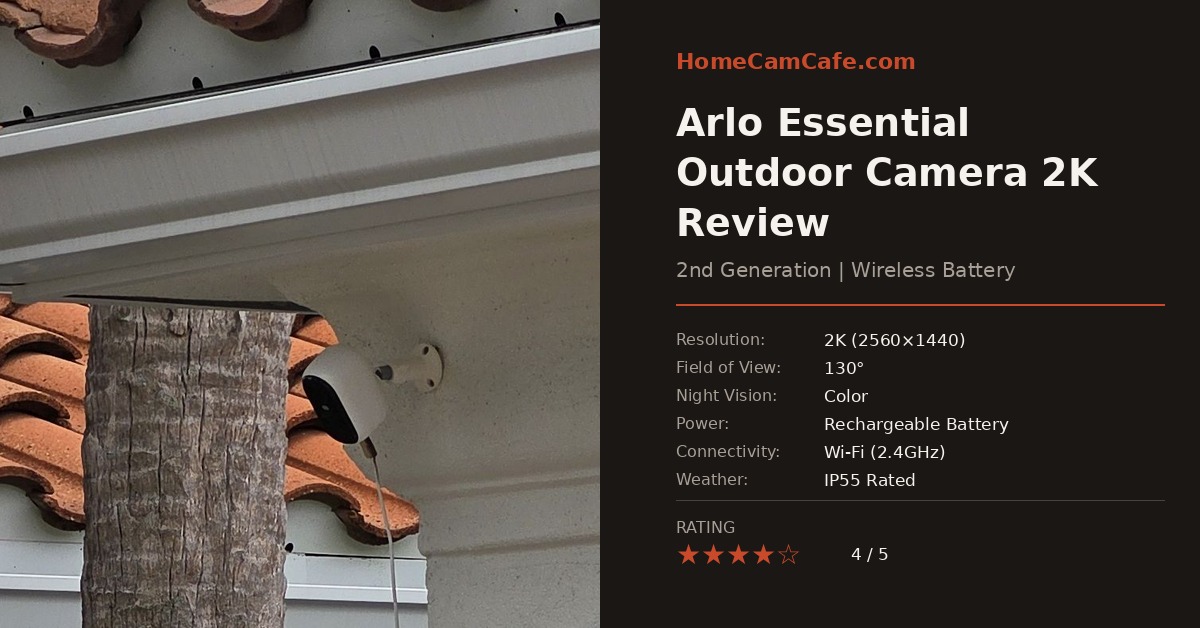
The Arlo Essential 2K is a compact, rounded bullet-style camera finished in matte white. At roughly the size of a squashed deck of cards, it blends well under soffits and along fascia boards without drawing too much attention. The IP55 weather rating means it handles rain and dust without issues, and in testing on a Florida eave — exactly the kind of humid, sun-baked environment that punishes lesser cameras — it showed no warping or seal deterioration.
The mount is a simple ball-and-plate system that provides a solid range of adjustment. Additionally, the magnetic charging port on the base makes recharging straightforward: you just pop the cable in without removing the camera from its mount. Overall, the hardware feels premium relative to the price point, and the clean white finish holds up well in direct sun.
Video Quality
Daytime video is where the Arlo Essential 2K impresses most. The 2,560 x 1,440 resolution produces footage that is sharp and rich in detail. For example, faces are recognizable at 25 to 30 feet, and the 12x digital zoom lets you pull in license plates or porch activity without the pixelation common in 1080p cameras. Colors pop, and exposure handles bright Florida skies well, recovering highlight detail in eave shadow areas without blowing out the sky.
The 130-degree field of view is wide enough for most entry points, though it is slightly narrower than some competitors at 160 degrees. In contrast to cameras that rely solely on infrared, the Arlo Essential uses a built-in spotlight to deliver color night vision. As a result, you can identify shirt colors, vehicle colors, and facial features after dark — a meaningful upgrade over black-and-white infrared footage.
Night Vision: Spotlight vs. Infrared
The distinction between spotlight-based color night vision and traditional infrared night vision is worth understanding before buying. Most budget outdoor cameras use infrared LEDs, which produce black-and-white footage with a characteristic gray-green glow. The Arlo Essential 2K instead activates its integrated white spotlight when motion is detected after dark, illuminating the scene and capturing full-color footage.
In practice, this approach delivers noticeably more useful footage. Color information — a red jacket, a silver sedan, a package label — is the kind of detail that matters when reviewing an incident clip. The spotlight range is effective out to roughly 20 to 25 feet, after which detail begins to soften toward the frame edges. Furthermore, the spotlight does have a secondary deterrence effect: it lights up and announces the camera’s presence, which can discourage casual intruders. If you prefer passive, invisible night monitoring, however, a camera with infrared-only night vision would be less conspicuous. That trade-off is worth considering for your specific installation.
One additional note: the spotlight activates only on motion triggers by default, not continuously. As a result, power draw is manageable, and battery life is not significantly impacted compared to IR-only cameras at similar sensitivity levels.
Battery Life and Solar Panel Option
Arlo rates the Essential 2K at two to six months per charge, and real-world results fall squarely in that range. At lower sensitivity settings with moderate traffic, three to four months per charge is realistic. If battery life is your top priority, the Arlo Essential XL 2K offers roughly four times the battery capacity in the same form factor.
For high-traffic locations where frequent recharging would be inconvenient, pairing the camera with an Arlo-compatible solar panel is the cleanest solution. A compatible panel trickle-charges the battery continuously, keeping it topped off without any manual intervention. Importantly, Arlo cameras are designed to detect a connected solar panel and adjust charging behavior accordingly — a generic USB panel with the right connector may not trigger that detection, resulting in slower or less reliable charging. For a full breakdown of which panels work with which Arlo cameras, see our Arlo solar panel guide.
It is also worth noting that the 2nd Gen Essential does not support Arlo’s SmartHub or Base Station, so local storage is not available on this model. All recorded footage routes to the cloud, which brings the subscription question directly into play.
Subscription: What You Get Free vs. What You Pay For
The subscription structure is the most important factor to understand before purchasing any Arlo camera, and the Essential 2K is no exception. Every camera ships with a 30-day Arlo Secure trial. After that trial ends, here is what changes depending on whether you subscribe:
| Feature | Free (No Plan) | Arlo Secure Plan |
|---|---|---|
| Live view | Yes | Yes |
| Two-way audio | Yes | Yes |
| Motion alerts | Yes | Yes |
| Cloud video storage | No | 30 days |
| Person / vehicle / package detection | No | Yes |
| Animated alert previews | No | Yes |
| Activity zones | No | Yes |
| 24/7 emergency response | No | Secure Plus only |
In short, the camera without a subscription is primarily a live viewer with motion pings — useful, but far below its potential. For a full breakdown of current plan tiers and pricing, see our Arlo subscription plans guide. The one meaningful upside: if you have multiple Arlo cameras, the subscription covers all of them under one plan, which significantly improves the per-camera value as your system grows.
Motion Detection and Alerts
Motion detection performance is strong. On default settings, the camera catches approaching people reliably from the full 25 to 30-foot detection range. False positives from passing cars and wind-blown foliage are manageable, and activity zones available with a subscription help filter out a busy street at the edge of the frame. With an Arlo Secure plan, AI-based person and vehicle recognition reduces nuisance alerts further. In addition, the integrated siren triggers loudly and quickly, useful both as a deterrent and for manual activation from the app during a live event.
Installation and Setup
Setup is fast. The camera connects directly to your 2.4GHz Wi-Fi network without a hub, and the Arlo app walks through the process step by step. Most users are fully configured in under 15 minutes. The included mounting plate uses three screws, and the camera locks securely into the magnetic ball mount. For soffit or eave installs like the one shown here, the angle adjustability is sufficient to aim the lens at the driveway or entry point without a secondary wedge mount.
Alexa and Google Home integration is straightforward, allowing you to pull up live feeds on Echo Show or Nest Hub displays with a voice command. IFTTT support additionally adds automation options such as triggering smart lights when the camera detects motion.
How It Compares: Arlo Essential 2K vs. Ring vs. Tapo C400
The Arlo Essential 2K competes most directly with other hub-free, battery-powered outdoor cameras. Here is how it lines up against the two closest alternatives:
| Arlo Essential 2K | Ring Outdoor Cam Plus | Tapo C400 | |
|---|---|---|---|
| Resolution | 2K | 2K | 1080p |
| Field of View | 130° | 160° | 111° |
| Night Vision | Color (spotlight) | Color (spotlight) | Color (spotlight) |
| Local Storage | No | No | microSD (free) |
| Subscription Required | For recordings & AI | For recordings & AI | No (SD card) |
| Battery Life | 2–6 months | 6–12 months | Up to 180 days |
| Hub Required | No | No | No |
Against the Ring Outdoor Cam Plus, the Arlo Essential 2K trades a wider field of view and longer battery life for a more refined app experience and slightly more flexible mounting. Both cameras are in a similar position on subscriptions: without a paid plan, neither stores clips. Ring’s battery life advantage is real, particularly for high-traffic or hard-to-reach installs.
The Tapo C400 is the most interesting alternative for subscription-sensitive buyers. It captures 1080p rather than 2K, and the field of view is narrower. However, it stores clips locally to a microSD card with no monthly fee, and person and vehicle detection are included free. If avoiding a subscription is your top priority, the Tapo C400 makes a compelling case. The Arlo Essential 2K, in contrast, justifies its position with superior video resolution, a more polished app, and stronger ecosystem depth.
Who Should Buy the Arlo Essential Outdoor Camera 2K
This camera is a strong fit for buyers who already have or plan to build an Arlo system. Because Arlo’s subscription covers multiple cameras under one plan, the per-camera cost of the subscription decreases as the system grows. As a result, the Essential 2K becomes progressively better value alongside an Arlo Pro or XL camera. It is also a good match for buyers who prioritize video clarity and app quality above all else, and who are comfortable with cloud-only storage.
Consider a different camera if:
- You want local storage without a monthly fee — consider the Tapo C400 with a microSD card instead
- Battery recharging is a major inconvenience — the Ring Outdoor Cam Plus offers a significantly longer charge cycle
- You need a wider field of view to cover a large driveway or open area — at 130°, this camera suits focused entry points better than broad coverage zones
What We Like
- Sharp, detailed 2K daytime video
- Color night vision with integrated spotlight
- Clean, responsive Arlo app
- Easy hub-free Wi-Fi setup
- Solid battery life at moderate sensitivity
- Two-way audio with noise canceling
What to Watch
- No local storage on 2nd Gen
- Smart detections require a paid subscription
- 130° FOV narrower than some rivals
- Night video can be soft at frame edges
Verdict
Arlo Essential Outdoor Camera 2K — 4 / 5
The Arlo Essential Outdoor Camera 2K is a well-built, capable wireless security camera that delivers excellent 2K video, effective color night vision, and one of the better apps in the category. The hub-free setup keeps installation simple, and the solar panel compatibility means recharging can largely become a non-issue for well-positioned installs. The subscription requirement for cloud storage and smart detections is a real ongoing cost, and the lack of local storage on the 2nd Gen is a genuine weakness compared to cameras like the Tapo C400. For buyers already in the Arlo ecosystem, or those who want premium video quality and a polished app experience, this camera delivers. For subscription-sensitive buyers, competing battery cameras offer a more cost-effective path.
For a closer look at how Ring’s battery camera compares, see the Ring Outdoor Cam Plus review. For a full breakdown of what each Arlo subscription tier includes, see the Arlo subscription plans guide. For all Arlo camera reviews and guides on this site, visit the Arlo cameras hub.